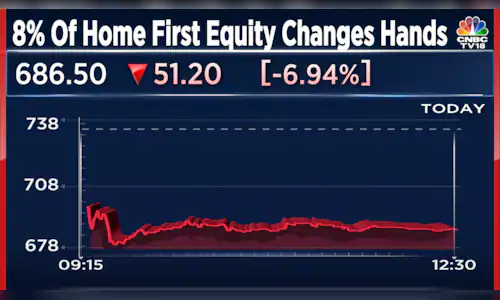
Shares of Home First Finance Company India Ltd. fell sharply in the latest trading session, sliding about 6% after a large block trade hit the market.
The selloff ended a four-day winning streak for the housing finance stock, which had gained steadily in the previous sessions.
The sudden decline drew attention from traders and retail investors, particularly because the drop followed a period of sustained upward momentum.

Market participants are now watching whether the fall marks short-term profit booking or signals a broader shift in sentiment toward housing finance companies.
Sharp Decline in Home First Finance Stock
Home First Finance shares dropped roughly 6% during the session, with trading volumes significantly higher than recent averages.
The decline came after a sizable block deal was executed on the exchanges, according to market data.

Large trades of this nature often create temporary price pressure, especially when supply outpaces immediate demand.
“There was visible supply in the counter after the block transaction,” said a Mumbai-based market dealer who tracks mid-cap financial stocks. “That typically leads to short-term price adjustments.”
The stock had previously logged four straight sessions of gains before the reversal.

Background: Home First Finance and Market Performance
Home First Finance Company India Ltd. operates as a housing finance firm focused primarily on first-time homebuyers in low- and middle-income segments.
The company has expanded its presence across several Indian states and has positioned itself as a retail-focused mortgage lender.
Housing finance stocks often respond to changes in interest rate outlook, liquidity conditions, and broader economic expectations.

In recent sessions, the sector had shown resilience amid steady credit growth data and stable borrowing conditions.
Timeline of Events
- The stock had gained for four consecutive sessions leading up to the latest trading day.
- A large block trade was executed during market hours.
- Shares fell approximately 6% following the transaction.
- Trading volumes rose significantly compared to recent averages.
The move appeared largely technical, driven by transaction dynamics rather than fresh company-specific announcements.
What Is a Block Trade and Why It Matters?
A block trade typically involves the purchase or sale of a substantial number of shares in a single transaction.

Such deals are often conducted by institutional investors, private equity firms, or major shareholders adjusting their holdings.
When a large seller enters the market, it can temporarily weigh on prices, even if the company’s fundamentals remain unchanged.
“Block deals don’t automatically indicate a negative outlook,” said Deven Choksey, managing director at KR Choksey Group. “Sometimes it’s just portfolio rebalancing or profit booking.”

However, investors often monitor these trades closely to understand whether there is a broader change in institutional sentiment.
Market Reaction and Investor Sentiment
The drop in Home First Finance shares prompted cautious reactions among short-term traders.
Retail investors appeared to reduce exposure during the session, while institutional activity remained under observation.
Analysts say that after a four-day rally, some degree of consolidation or profit-taking is not unusual.
“It’s common to see corrections after a short-term run-up,” said an equity strategist at a domestic brokerage firm. “The key is whether the stock stabilizes in the next few sessions.”
Broader market conditions also play a role. If overall indices remain steady, stock-specific corrections may remain contained.
Sector Outlook: Housing Finance Stocks
The housing finance segment has been supported by steady demand for affordable housing and stable credit growth trends.
Interest rate movements remain a central factor for lenders. Changes in borrowing costs can affect loan demand and margins.
For now, there have been no fresh regulatory announcements or company statements linked to the share price movement.
Market participants will continue to monitor upcoming earnings updates and loan growth data to assess the sector’s trajectory.
Official Statements
As of the latest update, Home First Finance had not issued any specific statement regarding the stock movement.
Block trades are typically disclosed through exchange filings, but they do not always come with detailed explanations about the parties involved.
Regulatory norms require transparency regarding significant shareholding changes, and further disclosures may emerge if thresholds are crossed.
What Happens Next?
Traders will be watching support levels in the coming sessions.
If the stock stabilizes and buying interest returns, the recent decline may be viewed as a temporary adjustment.
On the other hand, sustained selling pressure could indicate a shift in short-term sentiment.
Broader cues from the financial sector and benchmark indices are also likely to influence price action.
Key Facts Summary
| Event | Location | Date | Who Is Affected | Current Status | What Readers Should Know |
|---|---|---|---|---|---|
| Share price drop | Indian stock exchanges | Latest trading session | Shareholders, traders | Stock down about 6% | Fall followed a large block trade |
| Four-day gaining streak ends | Indian equity market | Same period | Investors in housing finance stocks | Rally halted | Profit booking may be a factor |
| Large block trade executed | Market transaction | During trading hours | Institutional participants | High trading volumes | Block trades can create temporary price pressure |
Frequently Asked Questions (FAQ)
Why did Home First Finance shares fall 6%?
The drop followed a large block trade that increased supply in the market, leading to short-term price pressure.
What is a block trade?
A block trade is a large-volume transaction executed between parties, often institutional investors.
Does a block trade mean negative news?
Not necessarily. It can reflect portfolio adjustments or profit booking rather than concerns about fundamentals.
Was there any company announcement?
As of the latest update, no specific announcement was linked to the price movement.
How did the stock perform before the fall?
Home First Finance shares had risen for four consecutive sessions before the decline.
What should investors watch next?
Investors may monitor trading volumes, support levels, and broader sector trends in upcoming sessions.
Conclusion
Home First Finance shares declined roughly 6% after a large block trade, ending a four-day rally.
While the move appears tied to transaction dynamics rather than new company developments, investors are assessing whether the drop represents short-term profit booking or a broader shift in market sentiment.
The next few trading sessions are likely to provide clearer direction as volumes normalize and sector trends unfold.










Leave a Comment